
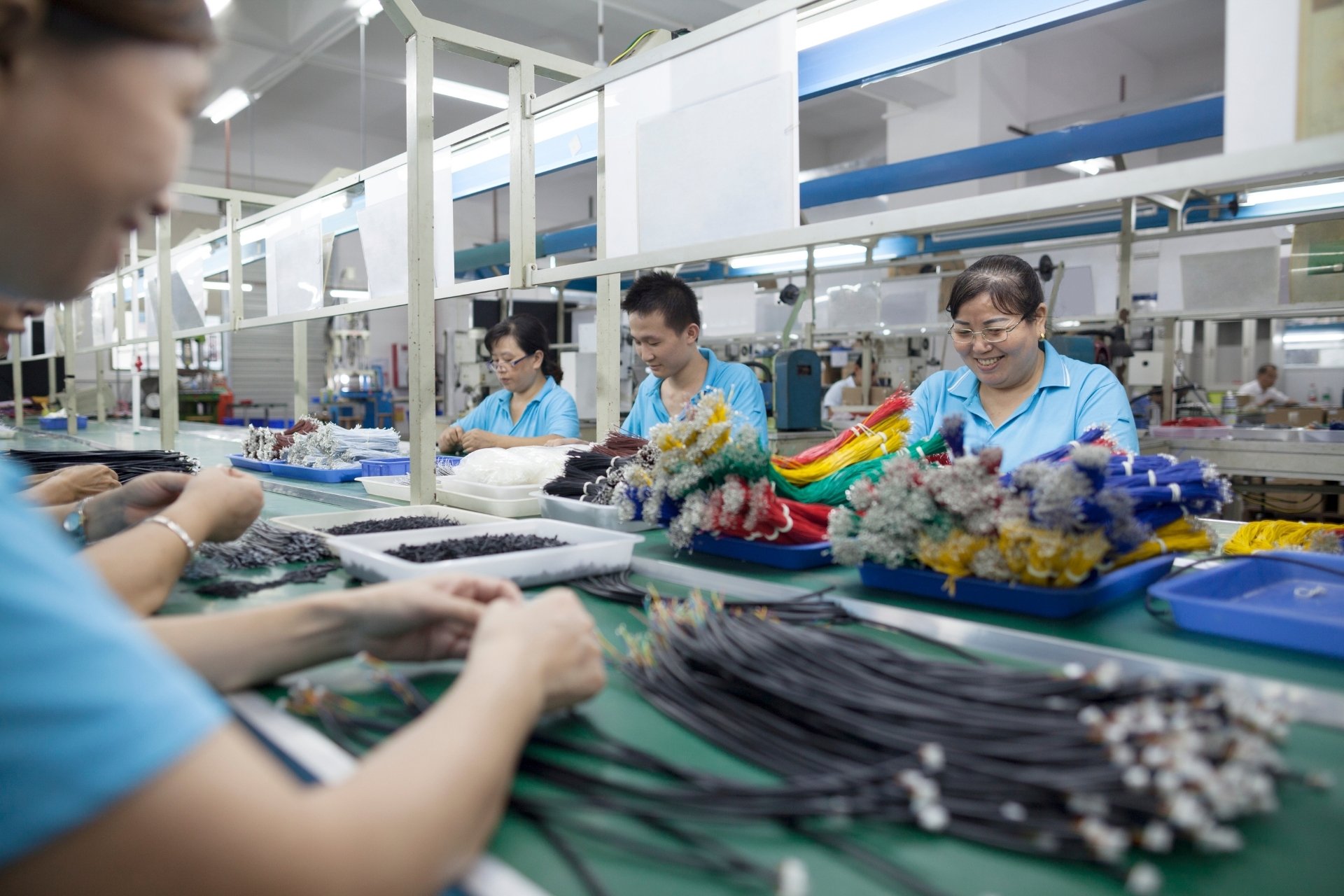

If you are building a hardware or physical product business, this Chinese manufacturing guide outlines how production has evolved far beyond low-cost contract manufacturing. Its core advantage has evolved into an unparalleled, full-cycle industrial ecosystem that connects product development, component sourcing, tooling, testing, production, and logistics.
Integrating official data from the Ministry of Commerce’s Guidelines for Foreign Investment and the National Bureau of Statistics, this guide serves as a practical landing manual for hardware entrepreneurs. It covers everything from supply chain integration to company establishment, tax incentives, and risk mitigation.
Why China’s manufacturing ecosystem is an advantage
China’s industrial system provides a concentration of capabilities that significantly shortens the journey from initial concept to commercially viable product.
Comprehensive industrial categories: China is the only country covering all 41 major industrial categories, 207 medium sectors, and 666 subsectors in the UN ISIC framework. Solutions for almost all production processes can be found domestically.
High-end manufacturing growth: Value added in industrial enterprises grew by 6.4% in 2025. Computer, communication, and electronic equipment manufacturing saw a 10.6% growth rate, while industrial robot output surged by 28%.
Advanced logistics: Chinese ports handled 354 million TEUs in 2025, ensuring products can be rapidly delivered to global markets.
Shorter product-development cycles with industrial clusters
For a physical product business, agile development means creating short, repeatable cycles between design, sourcing, production and customer feedback.
A typical cycle may involve producing a prototype, testing it with users, revising the bill of materials, updating tooling or packaging, validating the changes and releasing another batch. China’s supplier density can make these cycles easier to manage because many of the required capabilities are already present within established manufacturing clusters, such as electronics in Shenzhen, furniture in Foshan, or industrial automation in Suzhou.
The advantage is not simply that one factory can work quickly. It is that design, components, tooling, testing and assembly may be available within the same region, reducing the time spent coordinating suppliers across several countries. For example, founders can physically visit five mold factories within three days instead of waiting for cross-border emails, and they can adjust materials on the same day by meeting suppliers face-to-face.
Beyond factory assembly, the true moat includes robust local testing and an “engineer dividend”:
- Proximity to testing: Third-party CMA/CNAS testing laboratories are often located within a 50-kilometer radius, enabling a “submit samples in the morning, receive reports in the afternoon” turnaround for drop or EMC testing.
- Engineering talent: The manufacturing base provides millions of experienced Process Engineers (PE) and Quality Engineers (QE) capable of translating design drawings into mass-producible processes and resolving yield issues.
Digital infrastructure is supporting this development. In a January 2026 briefing, China’s State Council Information Office reported that more than 25,000 “5G Plus Industrial Internet” projects had been built, alongside 1,260 classified and graded 5G factories. These figures demonstrate the scale of China’s industrial digitalisation, although suppliers differ significantly in their technical maturity and operating standards.
Logistics capacity supports the final stage. Chinese ports handled 354.47 million twenty-foot equivalent units in 2025, an increase of 6.8 percent from 2024, according to the National Bureau of Statistics.
Supplier density alone does not guarantee a fast or reliable launch. Entrepreneurs still need to verify suppliers, establish quality-control procedures, define ownership of tooling and intellectual property, and agree on clear production and acceptance standards.
When a foreign-owned company becomes relevant
The term Wholly Foreign-Owned Enterprise, usually shortened to WFOE, remains widely used in international business. However, it is no longer a separate statutory category under Chinese law.
Since the Foreign Investment Law took effect in 2020, foreign-invested enterprises have been registered as companies or partnerships under China’s general corporate legislation. In practice, “WFOE” normally refers to a foreign-invested company owned entirely by one or more foreign investors, usually established as a limited liability company.
Not every entrepreneur working with Chinese suppliers needs to establish a company in mainland China. The decision depends on what the business needs to do locally.
A foreign-owned Chinese company may become relevant when an entrepreneur needs to:
- Employ staff directly in mainland China.
- Enter into contracts and manage supplier relationships through a local entity.
- Secure favorable payment terms, such as negotiating “Net 30” or “Net 60” agreements, which helps alleviate the cash flow pressure of upfront deposits typically demanded from overseas entities.
- Invoice customers or conduct other commercial activities in China.
- Manage local product development, sourcing or quality-control operations.
- Build a permanent operating presence without a Chinese equity partner.
Read our guide: WFOE, Joint Venture or Partnership: Which Chinese Business Entity is Right for You?
A locally registered company does not automatically protect intellectual property, guarantee supplier performance or remove compliance risks. Those matters still require appropriate contracts, registrations, internal controls and supplier due diligence.
The 2024 national negative list, effective from 1 November 2024, removed the remaining foreign-investment access restrictions specifically listed for the manufacturing sector. This expanded access does not mean that every manufacturing activity is unrestricted. Foreign-invested companies must still comply with the general Market Access Negative List and any applicable licensing, product, environmental, land-use, customs, data or export-control requirements.
Which tax incentives can a foreign-invested company qualify for?
The standard enterprise income tax rate for a Chinese resident company is 25 percent. Foreign-invested companies can qualify for generally available enterprise tax incentives when they meet the relevant conditions.
These are not WFOE-specific tax benefits. Eligibility depends on factors such as the company’s activities, technology, expenditure, employees, income, assets and location.
High and New Technology Enterprise status
A company accredited as a High and New Technology Enterprise can apply a reduced enterprise income tax rate of 15 percent.
Accreditation is not available automatically when the company is established. Among other conditions, an applicant must have been registered for more than one year, own qualifying intellectual property, operate within a state-supported high-technology field and satisfy requirements relating to R&D expenditure, technical personnel and revenue from high-technology products or services.
For example, scientific and technical personnel must generally represent at least 10 percent of employees, while revenue from qualifying high-technology products or services must account for at least 60 percent of total revenue. The required R&D expenditure ratio varies according to the company’s revenue.
For a new company, this is therefore an incentive to plan for rather than assume from the first year of operation, meaning R&D activities should be standardized from the very beginning of the company’s establishment.
Additional deduction for qualifying R&D expenditure
Eligible R&D expenditure can receive an additional 100 percent deduction when calculating taxable income.
This means that RMB 100 of qualifying R&D expenditure deducted as an expense may produce a total tax deduction of RMB 200. It does not mean that the company receives RMB 100 back or reduces its tax bill by the full amount spent.
When qualifying R&D expenditure creates an intangible asset, 200 percent of the asset’s cost may be amortised for tax purposes. The classification of R&D activities and the supporting technical, accounting and tax documentation should therefore be considered from the beginning of operations by establishing standardized R&D expense ledgers from day one.
Small and low-profit enterprise treatment
A foreign-invested company may also qualify for small and low-profit enterprise treatment, which is extremely friendly to foreign manufacturing teams in their initial startup stages.
Through 31 December 2027, qualifying companies calculate taxable income at 25 percent of its original amount and apply a 20 percent tax rate. This produces an effective enterprise income tax rate of 5 percent.
The company must operate outside industries restricted or prohibited by the state and meet all three conditions:
- Annual taxable income of no more than RMB 3 million.
- No more than 300 employees.
- Total assets of no more than RMB 50 million.
Employee and asset thresholds are generally calculated using average quarterly figures rather than a single year-end figure.
Encouraged-industry and reinvestment incentives
The 2025 Catalogue of Encouraged Industries for Foreign Investment took effect on 1 February 2026. It contains 1,679 activities and expands encouragement for areas including advanced manufacturing, high technology, modern services, energy conservation and environmental protection.
Inclusion in the catalogue may provide access to support measures, depending on the company’s activity and location. The catalogue does not create one standard tax rate for every qualifying business.
A separate policy applies to qualifying foreign investors that reinvest dividends received from Chinese resident companies into direct domestic investments. Between 1 January 2025 and 31 December 2028, eligible investors may receive a 10 percent corporate income tax credit when the invested enterprise operates within an industry included in the encouraged catalogue.
This is an investor-level incentive that benefits the foreign investors directly. It should not be presented as a general reduction in the foreign-invested company’s enterprise income tax rate. The investment structure and other eligibility conditions must also be satisfied.
Using this Chinese manufacturing guide to plan your corporate setup
The strongest China strategy connects the company structure with the product-development and manufacturing model. You should never blindly register a company just to enjoy tax incentives; always determine your company structure based on actual business needs.
Before establishing a foreign-owned company, entrepreneurs should determine:
- Whether a mainland Chinese entity is required at the current stage.
- Which activities need to appear in the company’s registered business scope.
- Whether the sector or product requires additional licences or approvals.
- Which manufacturing cluster offers the right combination of suppliers, skills and logistics.
- How much registered capital the company realistically needs.
- Where intellectual property and tooling will be owned and how they will be licensed or used.
- How suppliers, production quality and product acceptance will be managed.
- How R&D expenditure will be identified, recorded and substantiated.
- How VAT, customs, imports, exports, foreign exchange and profit repatriation will be handled.
To successfully manage these components, operators must mitigate key on-the-ground risks:
- Strictly observe Environmental Impact Assessment (EIA) red lines: Before leasing space or purchasing equipment, verify the park’s emission indicators support your process; neglecting the EIA is a more urgent operational risk than tax compliance.
- Confirm mold asset ownership: Molds are often more directly related to survival than patents. Explicitly stipulate in agreements that the funder owns the mold, prevent third-party usage, and maintain physical control over its storage location to avoid technology leakage.
Tax incentives should support the operating model, not determine it. Establishing a company around an incentive that its activities cannot substantiate can create unnecessary cost and compliance risk.
China offers significant advantages for entrepreneurs who need to develop, test and manufacture products at scale. Those advantages are strongest when supplier selection, location, intellectual property, tax planning and company registration are treated as connected business decisions.
Contact Prism China to assess whether a foreign-invested company fits your planned activities and how the business scope, location, ownership structure and registration process should be approached.
中国做产品创业,别只盯着“便宜工厂”了
从创意到量产,中国真正的优势是这套“产业生态组合拳”
很多海外创业者对中国制造的认知还停留在“成本低”——但2026年的现实是,中国对产品创业者最核心的价值,已经从“便宜代工”变成了“全链路产业生态”。
最近我们梳理了商务部《2025年外商投资指引》、国家统计局公开数据,以及最新的外资税收政策,给打算在中国做硬件、实体产品的创业者整理了这份落地指南:从供应链选择到公司注册,从税务优惠到合规红线,帮你少走弯路。
为什么中国现在还是产品创业的最优解?
先看一组官方数据:
- 中国是全球唯一覆盖联合国《全部经济活动国际标准产业分类》所有41个工业大类、207个中类、666个小类的国家;
- 2025年规模以上工业企业增加值同比增长6.4%,其中计算机、通信和其他电子设备制造业增加值增长10.6%,工业机器人产量同比增长28%;
- 2025年中国港口集装箱吞吐量达3.5447亿标准箱,同比增长6.8%,物流网络已经跑通了“从工厂到全球”的最后一公里。
这些数据背后,是创业者最关心的开发效率:
一款硬件产品从原型到量产,通常需要对接零部件商、模具厂、检测机构、组装厂、包装商。如果这些供应商都在同一个产业集群里(比如深圳的电子、佛山的家具、苏州的工业自动化),你可以:
- 3天跑完5家模具厂比价,而不是跨3个国家发邮件等回复;
- 原型测试出问题,当天就能找供应商调整材料,不用等跨境物流;
- 小批量试销后根据用户反馈改设计,不用重新搭建整个供应链。
加上现在国内已经有2.5万个“5G+工业互联网”项目落地,1260家分级分类5G工厂,供应链的数字化协同效率还在进一步提升。
⚠️注意:供应商密集不等于“躺赢”。你依然要做供应商尽调、定好质量验收标准、明确模具和知识产权归属——这些坑我们后面会提到。
什么时候需要在中国注册公司?
很多创业者第一步就踩坑:不是所有和中国供应链合作的情况都需要注册本地公司。
根据《外商投资法》,现在“外商独资企业(WFOE)”已经不是独立的法律主体,通常指在中国内地注册的外国投资者全资持股的有限责任公司。
只有当你需要以下操作时,才建议考虑注册中国本地主体:
- 要直接在中国内地招聘员工;
- 需要用本地主体和供应商签合同、管理账期;
- 要给境内客户开发票、做本地业务;
- 要在中国长期做产品研发、质检、供应链管控;
- 不想找中方股东,要100%控股运营实体。
2024年11月起,中国外资准入负面清单已经取消了制造业所有外资限制——也就是说,只要你不在禁止类目录里,制造业领域的外资可以100%控股,不需要中方参股。
但提醒一句:注册本地公司≠自动保护知识产权,也≠供应商一定会履约,合同、权属登记、内控这些工作还是得自己做。
这些税收优惠,符合条件就能申请
中国内地企业所得税标准税率是25%,但符合条件的外商投资企业可以享受三类通用优惠(不是WFOE专属,内资企业也能申请):
1. 高新技术企业:税率直接降到15%
如果你的业务属于国家支持的高新技术领域(比如电子信息、高端装备、新材料),且注册满1年、有自主知识产权、科技人员占比不低于10%、高新技术产品收入占总收入不低于60%,就可以申请认定。
对新公司来说,这是需要提前规划的政策,不是注册就能拿到的。
2. 研发费用加计扣除:花100元能抵200元税
符合条件的研发支出,在计算应纳税所得额时可以按100%加计扣除——也就是100元的研发投入,可以在税前扣除200元。如果研发形成无形资产,还可以按成本的200%在税前摊销。
⚠️ 建议从公司成立第一天就规范研发台账,留存技术、财务、税务的证明文件,不然到时候拿不到优惠。
3. 小型微利企业:实际税负只有5%
如果你的公司不属于限制/禁止类行业,同时满足“年应纳税所得额≤300万、员工≤300人、资产总额≤5000万”,截至2027年底,可以按应纳税所得额的25%计算税额,再按20%税率缴税,实际税负只有5%。
这个政策对新设的小团队非常友好,很多刚起步的外资创业公司都能符合。
4. 再投资激励:利润投鼓励类项目免10%预提税
2025-2028年期间,如果你把从中国居民企业分到的利润,直接再投资到境内的鼓励类产业项目(比如先进制造、节能环保,具体看《2025年鼓励外商投资产业目录》),可以免缴10%的预提所得税。
这个政策是给境外投资者的,不是直接降企业税率,要注意适用条件。
最后给你3个实操建议
我们接触过很多失败的案例,大多是“为了拿优惠而注册公司”,结果业务不匹配,反而增加了合规成本。真正稳妥的路径是:
- 先定业务,再搭架构:先想清楚你要不要在国内雇人、要不要做本地研发、要不要对接境内客户,再决定要不要注册公司,不要为了税收优惠硬凑条件。
- 知识产权提前布局:不管是模具设计还是产品专利,建议提前在国内申请权属,和供应商签合同的时候明确“知识产权归你所有”,避免后续纠纷。
- 产业集群优先选:做电子去深圳、做家具去佛山、做装备制造去苏州,不要只看土地便宜——供应链配套的效率比省几万块租金重要得多。
中国做实体产品的优势,从来不是“某一项成本低”,而是“所有环节都能找到靠谱的供应商,且都在你周边”。把这些环节和你的公司架构、税务规划、合规流程打通,才是真正的效率红利。
如果你正在考虑在中国落地产品项目,需要评估注册主体的必要性、经营范围设计或者合规流程,也欢迎联系我们进一步沟通。
版权说明:本文数据来自中国商务部《2025年外商投资指引》、国家统计局公开信息,政策内容仅供参考,具体落地请以主管部门最新要求为准。
Sources: National Bureau of Statistics, MOFCOM’s Foreign Investment Guide 2025 Measures for the Administration of High-tech Enterprise Accreditation, State Council Information Office briefing.